Skincare & Beauty
Performance creative for mature skincare brands
For US beauty and skincare brands serving women aged 50–70, Rocco Gagiano Studio develops concepts, scripts and short-form advertising assets built for creative testing. Casting, language and product explanation start with the woman buying.
This is part of our broader specialism: performance creative for the 50+ consumer. We work with brands targeting the United States, United Kingdom, Australia and Canada.
What we would test for a mature skincare audience
Four creative considerations to turn into testable hypotheses: casting, claims, texture and legibility. Your audience response and the performance feedback available determine what we keep and what we change.
The face on screen
Casting is the first thing we look at, and usually the cheapest thing to change — a decision more than a budget. Our working assumption is that a buyer in her sixties reads a much younger presenter as a signal that the advert is addressed to someone else, so we cast in the buyer's own decade unless the brief says otherwise. Whether that moves your numbers is a question your testing answers, not us.
What the claim is allowed to be
A buyer at this age has usually tried several products already, so we write as though a sweeping promise will be weighed rather than taken. Saying what the product does, over what period, to skin at this stage of life is harder to write and, in our view, easier to believe. The restraint is the strategy — not a guarantee that it converts better.
Texture shown honestly
Lines, pigmentation and thinner skin are often what the product is being bought for, so retouching them away can remove the very thing that shows the creative is addressed to the right person. We treat shooting and grading mature skin so it looks like itself — well-lit, premium, unsmoothed — as a production decision made at the start rather than a correction at the end.
Pace and legibility
Cut speed, caption size and how far the framing leans on irony are things we set deliberately rather than inherit from a younger-skewing template. We have no evidence that any of them costs older viewers more than younger ones, and we do not claim it — the point is that comprehension is a variable worth controlling, so nobody is lost in the first three seconds for a reason unrelated to the product.
Real creators, disclosed AI characters, and when each one fits
We use real creators when the creative depends on genuine personal experience, a real product demonstration or a testimonial. A customer account requires a person who actually used the product, their consent and an account that is theirs.
A disclosed AI character earns its place elsewhere: producing variations of a concept to find out which angle holds attention, keeping the same face across a test set so the variable is the message rather than the casting, or covering a consumer profile you have no creator for yet. It is a production method for exploring angles, not a stand-in for somebody's experience.
Where an AI character is used, it is disclosed in the work. The Digital Presenters is the roster those characters come from, and each one states which consumer profile it represents and how ready it is to use.
What to bring to a Creative Audit
None of this is mandatory. Bring what you have — the audit gets more specific the more of it exists.
- The creative you are running now. Live ads, organic posts, the product page — whatever a buyer currently sees.
- Who you think the buyer is, and who is actually buying. Where those two differ gives us a casting or messaging hypothesis to test.
- What the product does, with the wording you are allowed to use. Any claim constraints you already work under, so we write inside them rather than around them.
- Whatever creative feedback you have. If your media buyer can tell us which creative held attention and which did not, the angles we propose get much sharper. If that is not available, we say what we would test and why.
- Your product assets. Even one clean packshot is enough to start from.
The Digital Presenters · Skincare
The characters we would cast for skincare.
Each one is a finished, production-ready character with stills, motion and voice already produced. Press play on any of them — this is the casting a skincare test would start from, rather than a description of it.
 61
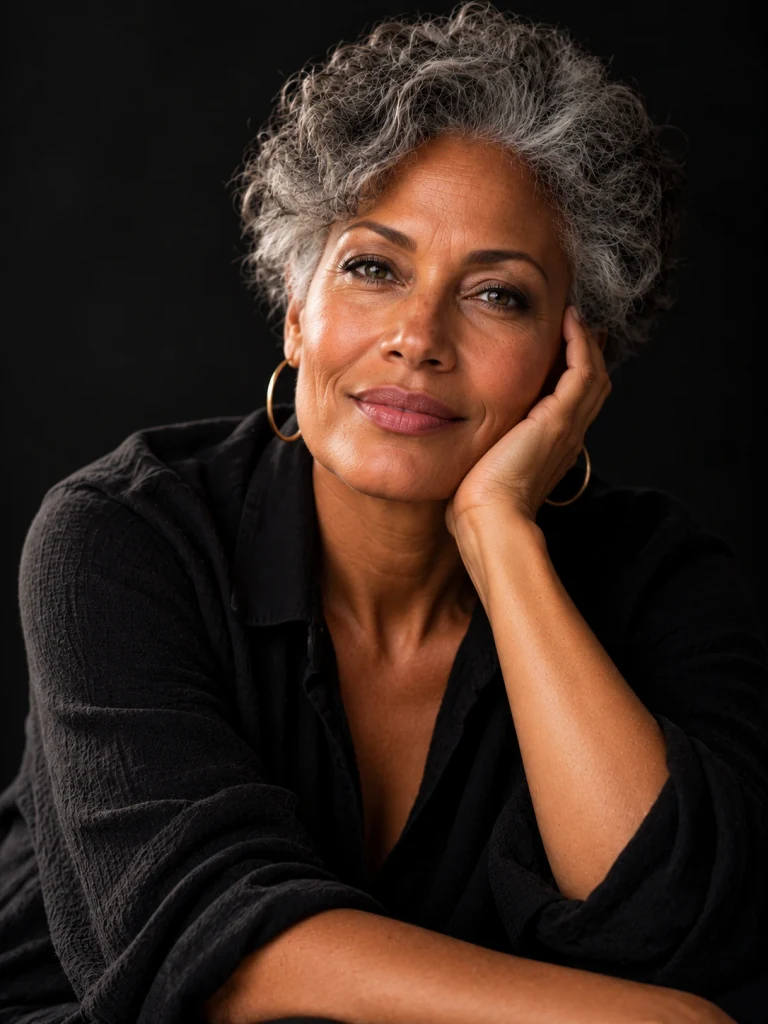
Vivienne, 61
The Reinventor
Second-act confidence, without the makeover cliché.
 54
Dawn, 54
The Caregiver
Buys for other people before herself.
 58
Iris, 58
The Silver Professional
Premium by default, discerning on principle.
 48
Priya, 48
The Pragmatist
In the middle of everything, and noticing the change.
Every character above is AI-generated and disclosed as such — never a real customer, testimonial or endorsement. See all the Digital Presenters for who each one represents and what they are ready for.
How one product asset becomes several creative concepts
A single packshot is a starting point, not a limit. From it we write a direction, place the product in a real setting with a character who matches the buyer, and build the hero piece plus the supporting formats around that — a piece to camera, a demonstration, a routine, a texture close-up, the product in use. Each one is a different argument for the same product, which is what makes them worth running against each other.
There is a worked example of exactly this on the site. The studio took one real Mediceuticals Cellagen packshot and produced ten stages from it as a single creative system. It is labelled on the site as a studio experiment, not a campaign: the product is real, the woman is an AI-generated character rather than a customer, and it has no audience result behind it. Of the ten stages, two are planning steps — the source asset and the creative direction board — and the other eight are finished frames in formats that could be tested. The finding is the count: one packshot carried the whole set.
See it under the studio's labelled client work and creative experiments, where each case states what it is and what has actually been verified. The same argument for haircare, where the before-and-after question is sharper, is on performance creative for mature haircare brands.
How we separate a demonstration from a customer testimonial
A demonstration
Shows what the product is and how it is used. It can be performed by a creator or by a disclosed AI character, because nothing about it depends on the performer having bought the product. It makes no statement about anybody's experience or result.
A testimonial
Is a real person saying what happened to them. It requires that person, their consent, and an account that is actually theirs. An AI character cannot give one, and a scripted performance of one is not a testimonial — it is a fabrication wearing the format.
The practical consequence is that testimonial-shaped language — real people, real results, before and after — is reserved for work that can carry it. Where a concept uses an AI character, the work says so, and the copy stays on what the product does rather than what it did for someone.
What we produce, and who handles testing
The studio develops creative strategy, concepts and scripts, then produces short-form advertising assets and variations for your channels. Formats can include pieces to camera, product demonstrations, routines and texture close-ups. Your proposal sets out which formats, variations and finished assets are included, with the timeline, revision allowance and usage rights.
Before work begins, we agree with you and your media buyer who buys the media, runs the tests and measures performance, what the tests will assess, and what feedback will reach the studio. Media buying and measurement are not automatically included. When performance feedback is shared with us, it informs the next creative iteration. Without it, we propose hypotheses to test rather than claim that an angle has worked.
No page on this site promises a return, a sales increase, a skin outcome or that any platform will approve a given ad. Those are not things a creative studio is in a position to guarantee.
From Creative Audit to paid Creative Pilot
Your Creative Audit is complimentary. Share your website and examples of your current creative. Within two business days of receiving the information we need, we'll email you a focused review with three creative opportunities for your 50+ audience and a recommended next step. No obligation to proceed.
If the audit points to a suitable next step, a paid Creative Pilot turns the recommendations into an initial set of advertising assets for testing. We agree the scope, price and deliverables before paid work begins. The Creative Audit scope and request form explain what to send and what the review covers. A Pilot can lead into a monthly creative partnership and Scale as the engagement develops.